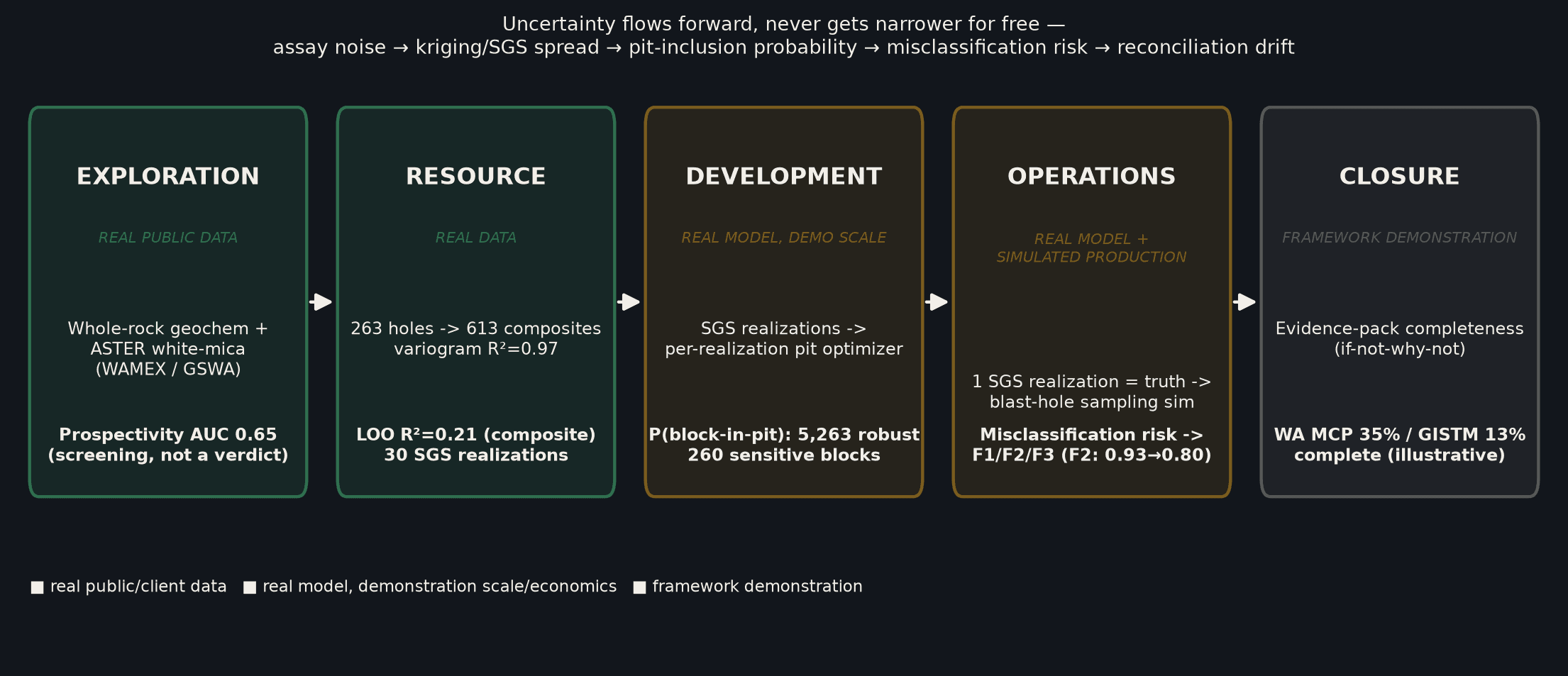
Every study on this page ran on 100% public data — open-file surveys, public drillholes, published maps. That is what makes an open showcase safe: no client project appears here, and every figure and number below is drawn from the committed study record, never written by hand.
The featured study is Pilgangoora — lithium, exploration to closure, all of it public. Winu and the NSW Macquarie Arc follow, each with its own honest verdict.
Featured study100% public data
Pilgangoora (Li) — exploration to closure
The full asset lifecycle, run on public data over the Pilgangoora lithium district (Western Australia): exploration screening, resource, development, operations and closure — with the uncertainty carried forward at every stage and every demonstration-scale step labelled as such.
Our own figure from the published study — the exploration-to-closure spine, uncertainty carried forward at every stage.
18.9% Li-silicate abundance predicted from whole-rock chemistry, against 20.8% measured independently by TIMA mineralogy.
Committed tripwire: if lepidolite ever appears in the predicted assemblage, the anchor fails.The bar lives in version-controlled code, not in prose.
A blind prospectivity test over the Winu Cu-Au discovery (Western Australia), on open-file data alone. The skill is modest and reported exactly as measured — every anchor below is quoted from the committed study record, tolerances included.
NSW Macquarie Arc (Cadia-Ridgeway · Northparkes) — a methods-and-limits study
Run end-to-end, blind, on 100% public NSW field data. It reproduces the documented geophysical reality of both porphyry districts — including, honestly, where regional potential fields do not localize deep or magnetite-destructive orebodies. That limit is the finding: a record that can show where a method stops working is a record you can trust where it does.
The full report is being prepared for public release; until then the study lives in the ledger.
These three are the cleared face of a larger discipline: ~24 blind, pre-registered studies, every verdict recorded as it came out. Every count below is computed from the committed ledger.